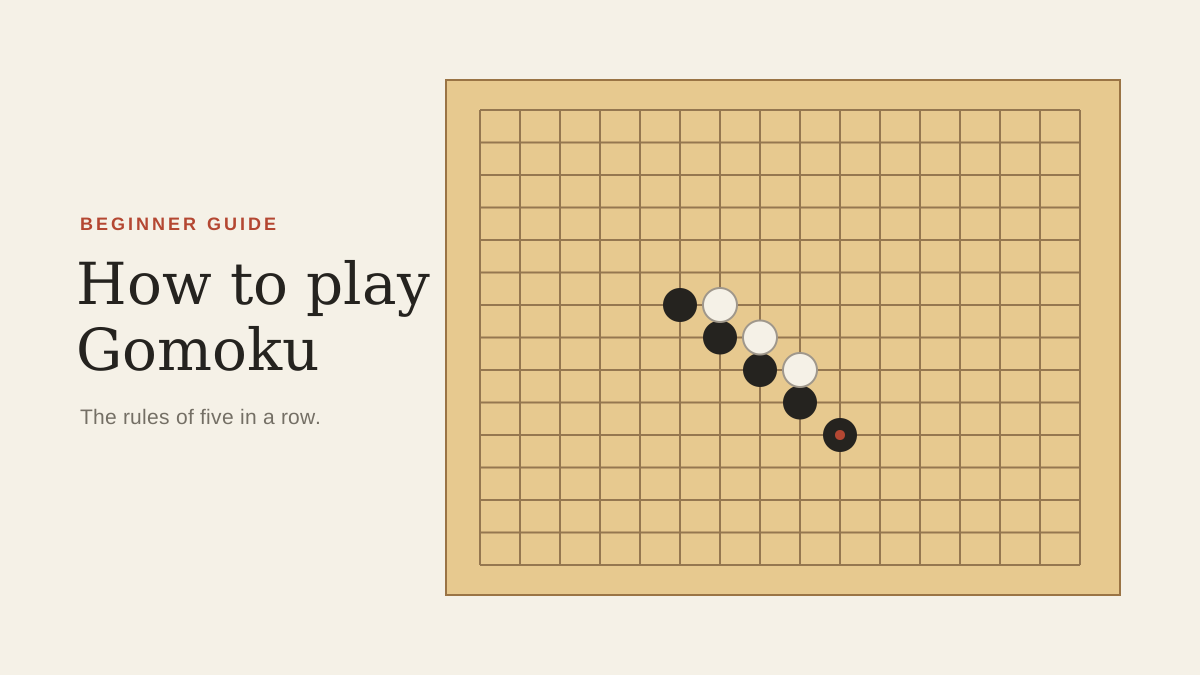
How Swap2 changed the Gomoku opening
Gomoku's first-player advantage did not disappear. Swap2 made the opening player's job much more uncomfortable, which is exactly the point.
Les articles sont actuellement disponibles en anglais.
Black moves first in Gomoku, and one move is enough to distort the game. A strong opening stone claims space while White begins by responding. Give that edge to an expert with a prepared line and a supposedly fair match can become a test of memory.
Tournament organizers tried several answers. The most durable idea was not to weaken a stone after play began. It was to make the opening player unsure which color they would eventually own.
The old fixes were too easy to aim around
One approach forced Black's first move to the center and required a later move to stay a certain distance away. This limited the strongest openings, but the same player still knew they would be Black. Opening study could concentrate on the allowed positions.
The basic swap rule went further. One player placed an opening set, then the other chose which color to play. A biased setup became dangerous to its creator: make Black too strong and the opponent takes Black; make White too comfortable and the opponent keeps White.
That is the pie-rule idea used in other abstract games. One person cuts, the other chooses.
The weakness was that a highly prepared player could offer a position whose true value they understood much better than the chooser. The board might be objectively balanced and still be practically one-sided.
The Swap2 procedure
Swap2 adds another decision:
- The first player places three stones, two black and one white.
- The second player may choose a color immediately.
- Instead, the second player may add one black and one white stone.
- If those extra stones are played, the first player chooses a color.
Normal alternating play then begins with the assigned sides.
It sounds awkward the first time. After a few games, the logic becomes clear. The person shaping the position cannot guarantee ownership of the better side. The second player can also decline the original offer and hand the final color choice back after adding two stones.
The opening becomes a negotiation
Under ordinary rules, an opening move asks, "How strong is this for Black?" Swap2 asks a harsher question: "Would I willingly play either color here?"
That changes preparation. A useful Swap2 opening should be understandable from both sides. Wild tactical positions are risky because the other player may know exactly which color to take. Quiet positions are not automatically safe; a small structural edge can matter for dozens of moves.
The protocol also creates a human contest before the regular game. Players judge confidence, familiarity and appetite for complications. A position can be balanced by analysis yet uncomfortable for one opponent.
What Swap2 does not do
Swap2 does not prove that every resulting game is mathematically equal. It does not remove opening theory. Strong players still prepare families of positions and study which color they prefer.
Its practical achievement is smaller and more useful. Neither participant receives Black simply because a pairing table says so, and neither can build a one-sided opening without offering the favored color to the opponent.
The Gomoku World Championship returned in 2009 with balanced opening rules, and recent championships use Swap2. That choice came after the first world events in 1989 and 1991, when competitive Gomoku was still finding a stable international format.
Try it after learning ordinary Gomoku
New players should first learn how open threes, fours and forks work. Swap2 is hard to judge without that vocabulary. Once ordinary openings begin to feel repetitive, the protocol is worth the extra minute.
The opening player still gets creative control. They just have to live with the possibility that their opponent will take the result.
Sources
Plus d’articles
Where Gomoku came from
The game has an ancient reputation, but its documented story begins much later. Here is what we can say without turning legend into fact.

How to Play Gomoku
Learn the board, turn order, winning condition, and first habits that make Five in a Row easier to understand.
Why Gomoku has so many names
Gomoku, Five in a Row, wuziqi, omok and gobang all point toward the same line-making game, though local rules can differ.
Newsletter
Join the community
Subscribe to our newsletter for the latest news and updates