Gomoku rules are a family, not a single rulebook
Freestyle, standard Gomoku, Renju and Caro look alike at first. Overlines, forbidden moves and blocked fives make them play differently.
Gli articoli sono attualmente disponibili in inglese.
Two people can know how to play Gomoku and still disagree about a winning line. Six black stones sit together. One player reaches for the score sheet. The other says it does not count.
Neither has necessarily misunderstood the game. They may have learned different branches of the same rule family.
Freestyle Gomoku
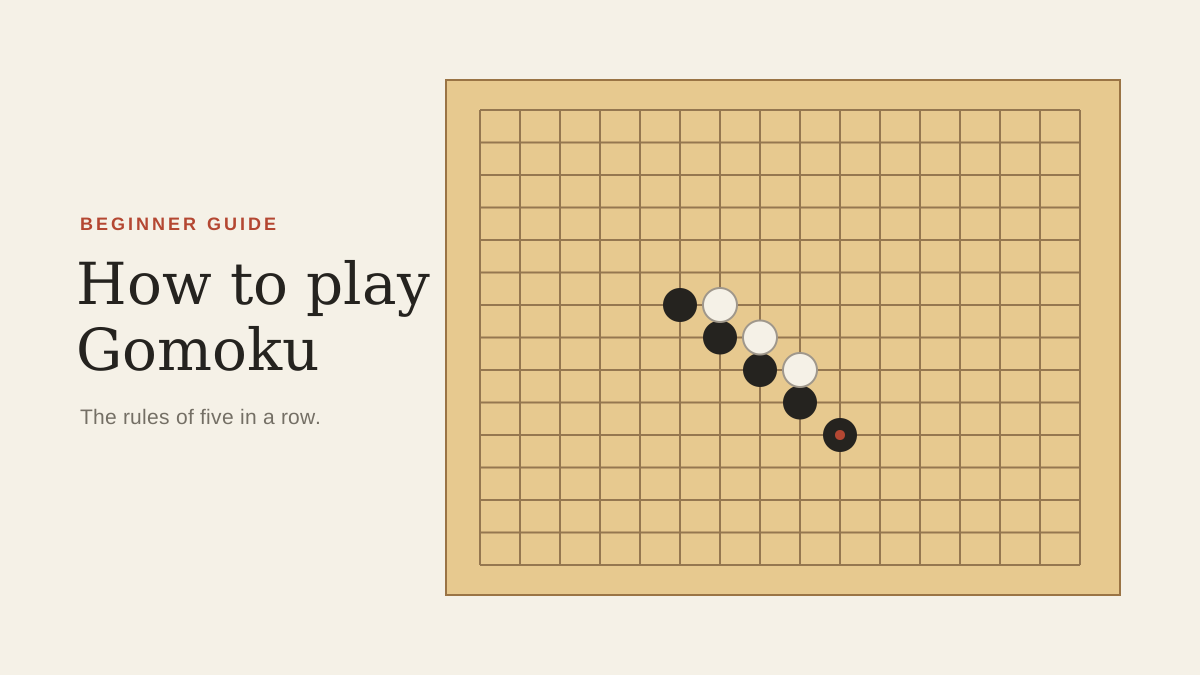
Freestyle has the lightest rule set. Players alternate placing black and white stones. Black moves first. An unbroken line of five or more wins.
The phrase "or more" matters. If your move joins two groups into a line of six, you win. There are no forbidden moves, so Black may create any fork that fits on the board.
This is a good form for a first game because the board always answers the same question: did someone make at least five?
It is not balanced at expert level. Black's extra tempo and control of the opening give the first player a large advantage.
Standard Gomoku
Standard Gomoku changes one detail: a winning row must contain exactly five stones. Six or more is an overline and does not win.
That sounds minor until a crowded position appears. A point that completes six may be useless, while a quieter move that produces exactly five ends the game. Defenders can sometimes exploit this by forcing an attacking line to grow past its target.
Standard rules usually leave other moves unrestricted. Black can still create double threes and double fours.
Renju
Renju was designed to reduce Black's advantage. White wins with five or more, but Black must make exactly five and may not play:
- a double three;
- a double four;
- an overline.
The definitions are technical. A shape that looks like a double three to a beginner may be legal because one branch cannot become a legal open four. Serious Renju play requires more than counting nearby stones.
These restrictions change defensive logic. White may threaten to steer Black toward a forbidden point. Black must calculate whether a promising fork is legal before treating it as a win.
The international Renju board has 15 lines in each direction, giving 225 intersections.
Caro
Caro is closely associated with Vietnam and is often played on squared paper. Rules vary, but a common competitive form requires exactly five and rejects a line blocked at both ends.
That last condition changes the edge of the board and closed shapes. A row of five wedged between enemy stones may fail to win even though the same row wins in standard Gomoku.
Because informal Caro traditions differ, ask for the local rule instead of assuming one universal version.
Opening rules sit on top
The winning condition is only half the rulebook. Tournaments also need a fair way to begin. Pro, Swap and Swap2 openings control early placement or let a player choose colors after seeing an opening position.
These protocols do not change what five stones mean. They change who has to play the position.
A listing such as "Gomoku, Swap2" therefore tells you two things: which lines win and how colors are assigned at the start.
Pick rules that fit the table
Freestyle is quick to explain and forgiving for casual play. Standard Gomoku makes overlines matter. Renju rewards players who want a precise body of foul rules. Swap2 Gomoku is the usual direction for balanced unrestricted tournament play.
Write the choice down before starting. A one-line rule note prevents a twenty-move game from ending in a debate.
Sources
Altri articoli
Why double threats win Gomoku games
One threat can be blocked. Two threats created by the same stone often cannot. Learn how forks form and how to spot them early.

Why Gomoku has so many names
Gomoku, Five in a Row, wuziqi, omok and gobang all point toward the same line-making game, though local rules can differ.
Where Gomoku came from
The game has an ancient reputation, but its documented story begins much later. Here is what we can say without turning legend into fact.
Newsletter
Join the community
Subscribe to our newsletter for the latest news and updates