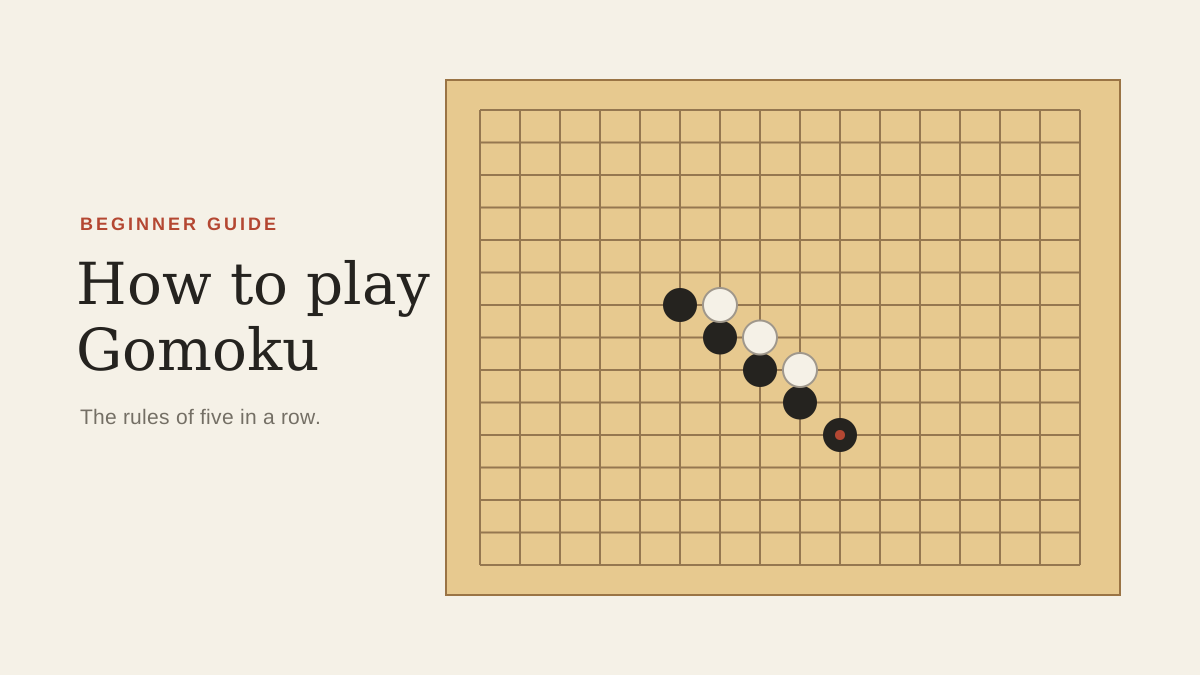
How to defend without surrendering the game
Blocking the nearest stone is often legal and often wrong. Better defense removes future branches and creates a counterthreat.
글 본문은 현재 영어로 제공됩니다.
Bad defense feels busy. You block a three, then another three, then a four. Ten moves later your stones form a trail around the opponent's position and none of them work together.
The blocks were individually correct. The defensive plan still failed.
Answer the threat that has a deadline
Start with the immediate question: can the opponent win next move? If yes, block the winning point or make your own win. Do not improve a separate area of the board.
If there is no immediate five, check whether the opponent can create an open four. Preventing that move is usually more urgent than blocking a closed three.
This sounds obvious when written down. At the board, a long row attracts attention even when a short jump shape has the earlier deadline.
Compare all legal blocks
A line often has two ends. Blocking either one stops the same immediate extension, but the resulting positions are not equal.
One block may:
- point toward the center;
- connect with one of your stones;
- take away a crossing point needed for a second threat;
- push the attacker toward the edge.
Choose the block that does extra work. A defensive stone is still one of your stones. If it never joins another line, you paid a full turn for a temporary patch.
Defend the shape, not the last stone
The newest stone is not always the source of danger. An attacker may place it as a forcing move to make you ignore an older diagonal.
Trace every line through the new stone, then look for the follow-up point. If you block that point, ask what remains. Does the attacker have another four? Can the same support stone create a fork in a different direction?
Good defense breaks the attack's network. Sometimes that means playing one space away from the visible row because that intersection links two future branches.
Counterthreats buy tempo
If you can create a four while answering a threat, the opponent must stop and respond. This is active defense.
A counterthreat played elsewhere can also work, but only if it is more urgent than the attack you ignored. A single closed four does not save you from an opponent's open four. They will win first.
Tempo calculations should be literal:
- If I play here, where can they win?
- If they must reply to me, how many replies do they have?
- After the forced reply, is their original attack still alive?
Do not label a move "forcing" until you have answered those questions.
Use the edge carefully
The board edge closes a line without placing a stone. Steering an attack toward it can reduce an open shape to a one-ended shape.
The edge can also trap the defender. There is less room for a counterattack, and diagonal threats are easy to misread near a corner. Treat the boundary as a permanent occupied end, then count the remaining winning points.
Know when the position is already lost
Some positions contain no defense. An open four has two winning points and you can cover only one. A clean four-four presents the same problem on separate lines.
Finding that loss is useful. Rewind one move and look for the last position where a single block worked. That is the defensive error worth remembering. The final move was only confirmation.
Defense in Gomoku is not the art of saying no to every stone. It is the art of making one move answer more than one future question.
Rules reference
더 많은 글
Gomoku rules are a family, not a single rulebook
Freestyle, standard Gomoku, Renju and Caro look alike at first. Overlines, forbidden moves and blocked fives make them play differently.

Where Gomoku came from
The game has an ancient reputation, but its documented story begins much later. Here is what we can say without turning legend into fact.
How to Play Gomoku
Learn the board, turn order, winning condition, and first habits that make Five in a Row easier to understand.
Newsletter
Join the community
Subscribe to our newsletter for the latest news and updates