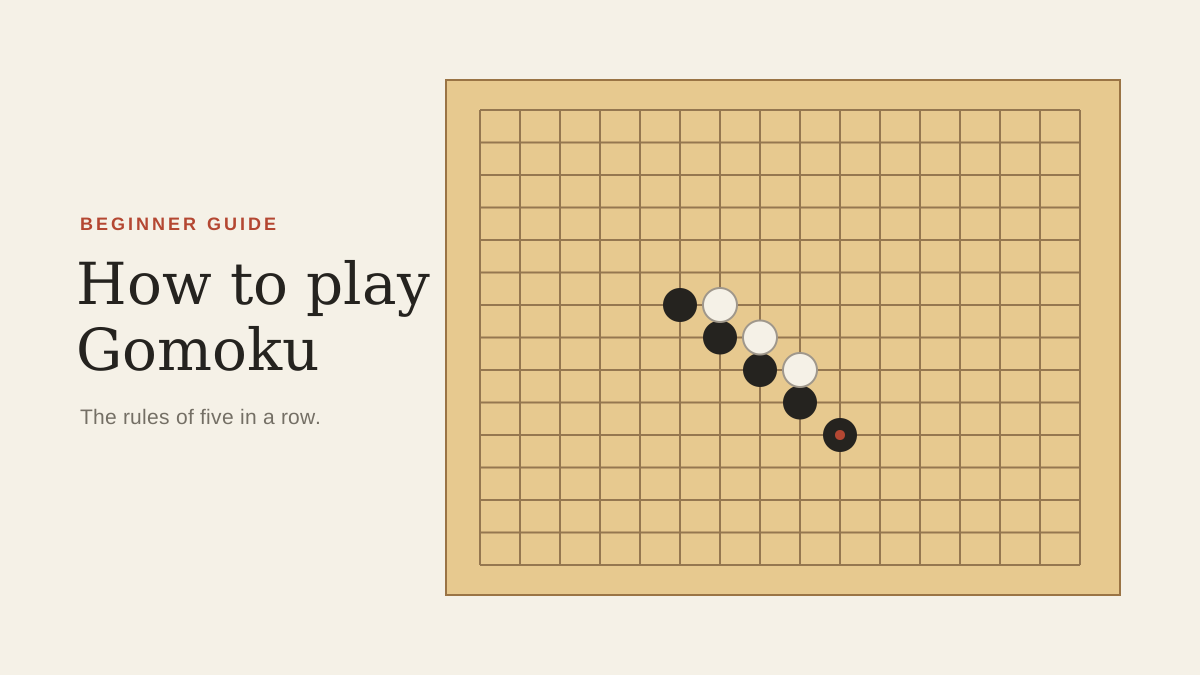
The stop-and-start story of the Gomoku World Championship
The first world title was awarded in Kyoto in 1989. Then the event vanished for eighteen years before balanced openings brought it back.
Тексты статей сейчас доступны на английском языке.
The first Gomoku World Championship took place in Kyoto in 1989. Sergey Chernov won. Two years later, Yuriy Tarannikov took the title in Moscow.
Then the championship stopped.
That gap is one of the more revealing stories in Gomoku. An international organization existed, strong players existed, and the rules were easy to understand. The hard part was finding a competitive opening system people trusted.
A federation for two related games
Japan, the Soviet Union and Sweden founded the Renju International Federation in Stockholm on August 8, 1988. Renju was its main discipline, but Gomoku was part of the program too.
The first world events arrived quickly. Kyoto hosted both Renju and Gomoku competition in 1989. Moscow followed in 1991.
Renju already had a long project behind it: restrict Black's strongest forks and overlines, then refine the opening protocol. Gomoku kept fewer restrictions, which made the first-player problem harder to contain.
The federation discontinued the Gomoku world event after 1991.
Eighteen years away
There was no Gomoku World Championship in 1993, 1995 or the years that followed. Competitive Gomoku continued in national events and online play, but the world title remained dormant.
During that period, players tested opening rules that assigned colors after some stones were already on the board. Swap systems made it dangerous for one participant to offer a position that strongly favored Black, since the other participant could choose Black.
The world championship returned in 2009 in Pardubice, Czechia. Artur Tamioła won the first event of the new era. The official championship history describes the restart as using new balanced opening rules.
A European circuit takes shape
Later championships moved among Sweden, Estonia, Russia, Czechia and Hungary. Attila Demján won in 2011 and defended the title in 2013. The winners since the restart also include Rudolf Dupszki, Zoltán László, Martin Muzika and Pavel Laube.
Laube won in Budapest in 2023 and again in Brno in 2025. The list matters less as a parade of names than as evidence of continuity. After the eighteen-year break, the championship settled into a recurring international event.
The geography is notable. Gomoku has deep East Asian roots and strong Asian players, yet the revived world championship has often been hosted in Central and Northern Europe. Sweden and the former Soviet scene were already important to Renju's international growth in the 1980s, so this was not a sudden relocation.
Rules made the event possible
Sports histories often focus on champions. Gomoku's championship history turns on rule design.
Without a credible opening, the color draw weighs too heavily. With a swap protocol, opening preparation becomes a two-sided offer. Players still search for an edge, but they cannot assume they will keep the color favored by the position they create.
The long break between Moscow and Pardubice shows how much that detail matters. Five stones still won in both eras. The method for reaching move one changed enough to revive a world title.
Sources
Другие статьи
How to defend without surrendering the game
Blocking the nearest stone is often legal and often wrong. Better defense removes future branches and creates a counterthreat.

Why programmers keep teaching computers Gomoku
Gomoku is easy to encode and brutal to search. That combination has supported decades of work on threat search, pruning and neural networks.
Why Gomoku has so many names
Gomoku, Five in a Row, wuziqi, omok and gobang all point toward the same line-making game, though local rules can differ.
Newsletter
Join the community
Subscribe to our newsletter for the latest news and updates