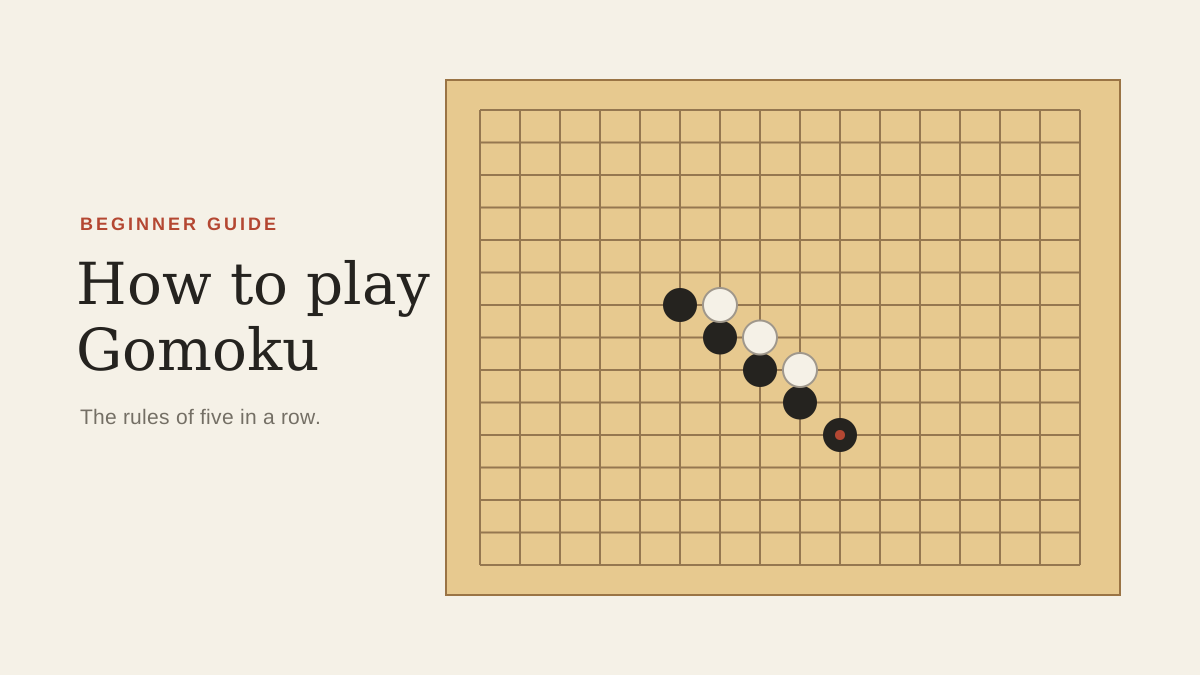
The geometry of a Gomoku board
Center, edge and corner points do not offer the same attacking room. Counting lines explains why strong openings stay near the middle.
Die Artikel sind derzeit auf Englisch verfügbar.
Every empty intersection accepts a stone, but the intersections are not equal. A stone near the center can grow in four directions with room on both sides. A corner stone has fewer futures before either line hits wood.
That geometric fact explains much of opening play without requiring a book of memorized sequences.
Four lines pass through a central point
Place a stone near the center of a 15 by 15 board. It belongs to one horizontal line, one vertical line and two diagonals. Each line extends on both sides, so the stone can support several open shapes.
Move the same stone to an edge. The horizontal or vertical line may end immediately on one side. In a corner, two main directions lose half their space, and one diagonal is much shorter.
The stone still counts toward five. It simply has fewer ways to get there without becoming closed.
Distance five is the first useful measure
For an intersection to sit inside a winning row, there must be room for a five-point segment containing it. Near the middle, many such segments overlap. Near a boundary, only a few fit.
This gives central stones latent value. A single move can belong to multiple possible fives along the same line, so the opponent cannot identify your final segment early.
An edge attack reveals its limits sooner. Once the available segment is clear, the defender knows which points matter.
Diagonals are visually deceptive
Players see horizontal and vertical distance easily because the board frame supports the eye. Diagonals require more care, especially when stones are separated by gaps.
Use coordinates or count intersections with a finger. A diagonal that appears to have room may strike the top edge before it can form an open four. The opposite mistake also happens: a broken diagonal hides behind stones from unrelated rows and receives no defense.
After each move, scan both diagonals deliberately. Do not rely on peripheral vision.
The center is valuable, not magical
Playing near the center preserves options, but a central move with no relation to existing stones can waste a turn. Once tactics begin, urgency outranks geometry.
A move near the edge may be best because it forms a four. A move in the center may be useless because the opponent wins elsewhere. Positional advantages matter only when no forcing sequence overrides them.
This is why opening advice should say "keep room around connected stones" rather than "always play in the center."
Use boundaries as defenders
The edge blocks growth for both players. A defender can sometimes choose the side of a threat that leaves the attacker advancing toward the boundary. Each later move has less room to branch.
An attacker can exploit the same boundary when exact-five rules apply. If an overline does not win, the edge may help control the final length of a row. Under Caro-style rules, whether the winning five is blocked at both ends may matter as well.
Geometry therefore depends on the rule set. The physical board stays put, but the value of its boundaries changes.
A simple opening exercise
Put one black stone at the center. For each of the four lines through it, mark every five-point segment that includes the stone. Repeat with a stone two spaces from the edge.
You do not need to finish the count to notice the difference. The center stone belongs to more possible wins and keeps both ends alive more often.
That is the quiet reason central play works. It does not make a threat today. It keeps more threats available for tomorrow.
Rules reference
Weitere Artikel
Gomoku rules are a family, not a single rulebook
Freestyle, standard Gomoku, Renju and Caro look alike at first. Overlines, forbidden moves and blocked fives make them play differently.

Where Gomoku came from
The game has an ancient reputation, but its documented story begins much later. Here is what we can say without turning legend into fact.
Learn to read Gomoku threats
Stop counting only the longest line. Open ends, gaps and the number of winning points tell you which shape matters now.
Newsletter
Join the community
Subscribe to our newsletter for the latest news and updates